
बेहतर अनुभव के लिए अपनी सेटिंग्स में जाकर हाई मोड चुनें।


© 2017-18 Amar Ujala Publications Ltd.
[ad_2]
Source link
बेहतर अनुभव के लिए अपनी सेटिंग्स में जाकर हाई मोड चुनें।
© 2017-18 Amar Ujala Publications Ltd.
The policies direct sections to systematically track sexual harassment claims. Each allegation must specify the nature of the claim, whether it was reported to the inspector general or to security, and the disciplinary action taken. And they say that managers must account for such allegations before giving an employee an award or other public commendation.
But the guidelines allow each unit to decide how best to enforce many of the new directives, a decision that critics say does not comply with one of the inspector general’s top recommendations of equal policy enforcement across the department.
The department’s sprawling network of prosecutorial offices and other outposts employ more than 115,000 staff members. The different sections also have different reputations concerning how they treat employees.
“There should not be discretion among components in how each applies a directive,” said Cathy Harris, an employment lawyer at Kator, Parks, Weiser & Harris. “You could have one component say it will wait 30 days after a complaint before investigating it, whereas another could launch an investigation within a business day. What we need here is top-down leadership.”
Over the past five years, the inspector general has issued at least four reports detailing episodes of harassment, assault and sexual misconduct at the department, including the solicitation of prostitutes and employees asking colleagues to watch pornography.
In the most recent report, issued in May, Mr. Horowitz described instructors who had slept with trainees and an employee who had stalked a colleague. Managers were inconsistent in how they punished wrongdoers, he said, and in whether they enforced those penalties.
The deputy attorney general and his office have been slow to respond. Mr. Horowitz gave the department 60 days after that report was released to indicate how it would address his concerns. Mr. Rosenstein issued the policies eight months after that deadline.
Soon after the May report, a group of Justice Department employees asked to meet with the deputy attorney general’s office, according to employees briefed on those requests. In a letter written in August, they sought to be part of any next steps. Officials responded to that letter in December.
Over the past year, two women have come forward to publicly accuse colleagues of retaliation after they reported sexual harassment. A Times investigation in March found that officials had ignored years of complaints that supervisors in the death penalty unit had engaged in gender discrimination and sexual harassment. The department investigated some of the allegations, one of which was supported by texts and firsthand accounts, but the men are still department employees.
Three days after The Times published its article, Mr. Horowitz met with Justice Department employees to talk about sexual harassment. Hundreds packed the department’s Great Hall, filling seats and lining the perimeter of the room.
The moderator for the event told fellow employees that department officials had responded to the inspector general’s report last year by saying that the episodes he uncovered had all occurred under the Obama administration. Mr. Horowitz said that sexual harassment was a systemic issue and that he hoped it would be taken seriously “no matter who’s in charge.”
Employees told Mr. Horowitz that they were frustrated that people were rarely fired after being found guilty of harassment and assault. He replied that people in the department were taking “far more seriously” issues that in the past had not, and that his office had seen cases that resulted in terminations that “we’re not sure in the past would have been handled as terminations.”
Mr. Horowitz said that the department was likely to enforce more severe punishments as it took harassment more seriously.
The Justice Department’s new policies make explicit that substantiated sexual harassment cases should result in “a penalty ranging from a 15-day suspension to removal.”
But Mr. Horowitz warned at the meeting that the department could face other challenges as it became more wiling to issue harsher penalties. Individuals found guilty of wrongdoing “often challenge some of the harsher, you know stronger penalties.” He said that in the past, their punishments have been softened after they pushed back.
“If you have zero tolerance, how can you permit people found to have committed more egregious acts of harassment or assault to continue to work and walk the halls?” said Ms. Harris, the lawyer. “The Justice Department is a very prestigious place to work. They can enforce true zero tolerance and fire people, which is what is happening in corporate America right now.”
At the death penalty unit, the deputy supervisor there was accused of groping his administrative assistant at a restaurant, trying to persuade her to check into a hotel and sending her texts offering to give her money or take her on a trip. Colleagues who had witnessed the episode at the restaurant and read the texts told managers and the inspector general. That supervisor still works at the Justice Department and is appealing the department’s decision to move him to a different unit.
“The question this raises is who does the Department of Justice prioritize?” Ms. Harris said. “Right now, they’re worried about being sued by harassers. They should be worried about being sued by the victims whose claims are ignored. That will be much more damaging to the department’s reputation.”
An earlier version of this article misattributed a statement referring to how Justice Department officials responded to a sexual harassment report. It was a Justice Department employee, not Michael E. Horowitz, the department’s inspector general, who said that officials had responded by saying that those episodes had all occurred under the Obama administration.
An earlier version of this article also incorrectly stated how Mr. Horowitz believed the department would begin to respond to sexual harassment. He said that he believed the department would fire more people than it had in the past and that people who receive harsher punishments often push back, not that he believed the department would not fire more people and would be sued.
नई दिल्ली (जेएनएन)। पाकिस्तान में इस्लाम न मानने वालों अथवा इस्लाम से जबरन खारिज किए गए लोगों के साथ किस कदर बदसलूकी होती है और उस पर वहां की नेशनल एसेंबली यानी संसद भी मुहर लगाने में संकोच नहीं करती, इसका एक शर्मनाक प्रमाण गुरुवार को तब फिर मिला जब इस एसेंबली ने अहमदिया समुदाय के नोबल विजेता वैज्ञानिक प्रो अब्दुस सलाम के प्रति घोर असम्मान जताते हुए कायदे आजम विश्वविद्यालय में उनके नाम पर रखे गए नेशनल फिजिक्स सेंटर यानी फिजिक्स डिपार्टमेंट से उनका नाम हटाने के एक प्रस्ताव को मंजूरी दे दी। यह प्रस्ताव मंजूर होने की खबर मिलते ही विवि ने उनका नाम तत्काल प्रभाव से हटा भी दिया। इस प्रस्ताव में यह भी कहा गया है कि इसे याद रखा जाना चाहिए कि पाकिस्तान दो राष्ट्र के सिद्धांत पर बना था। प्रस्ताव की ऐसी भाषा पाकिस्तान के अल्पसंख्यकों के लिए खतरनाक मानी जा रही है। एक अजीब बात यह भी है कि यह प्रस्ताव पूर्व प्रधानमंत्री नवाज शरीफ के दामाद कैप्टन सफदर लाए थे। सबसे शर्मनाक यह रहा कि यह प्रस्ताव सर्वसम्मति से पारित हुआ। इस प्रस्ताव के पारित होने के बाद पाकिस्तान की सिविल सोसाइटी के लोग और कई पत्रकार, मानवाधिकारवादी अपने सांसदों को कोसने में लगे हुए हैं। ज्यादातर का स्वर यही है कि इस मुल्क का कुछ नहीं हो सकता।
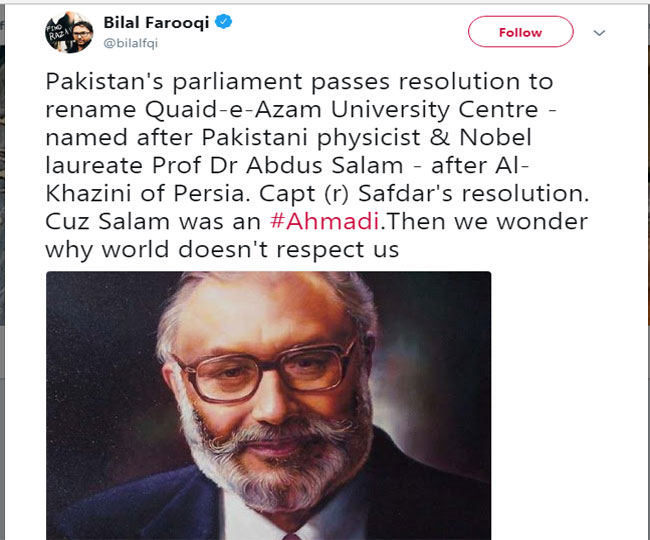
अब्दुस सलाम की बेकदरी करने वाला यह प्रस्ताव इसलिए भी हैरानी भरा रहा, क्योंकि इस्लामाबाद के कायदे आजम विश्वविद्यालय के फिजिक्स डिपार्टमेंट का नाम अब्दुस सलाम के नाम पर रखने का फैसला 2016 में नवाज शरीफ के प्रधानमंत्री रहते समय लिया गया था। इस विवि के फिजिक्स डिपार्टमेंट को अब्दुस सलाम का नाम दिए जाने की पहल पाकिस्तान की सिविल सोसाइटी और खासकर शिक्षक, वैज्ञानिक आदि एक अर्से से कर रहे थे। अब्दुस सलाम के नाम को फिजिक्स डिपार्टमेंट से खारिज करने के नेशनल एसेंबली के फैसले को अल्पसंख्यकों की अनदेखी और उपेक्षा के बढ़ते सिलसिले के तौर पर देखा जा रहा है। ज्ञात हो कि हाल के समय में पाकिस्तान में अल्पसंख्यकों पर हमले बढ़े हैं।
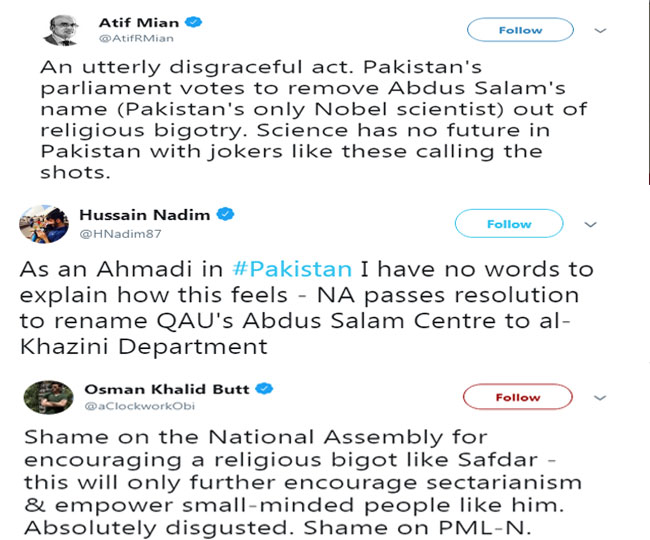
अब्दुस सलाम को जब नोबेल पुरस्कार मिला था तो उन्हें यह सम्मान पाने वाले पहले मुस्लिम वैज्ञानिक के तौर पर देखा गया था। वह पाकिस्तान के एक मात्र ऐसे वैज्ञानिक रहे हैं जिन्हें नोबेल सम्मान मिला, लेकिन उन्हें अपने ही देश में कदम-कदम पर बेइज्जत किया गया। यह सिलसिला उनकी मौत के बाद भी जारी रहा। पहले उनकी कब्र में उनके नाम से यह उल्लेख हटा दिया गया कि वह मुस्लिम हैं और अब उनके नाम वाले फिजिक्स डिपार्टमेंट का नया नामकरण कर दिया गया। पाकिस्तान में अहमदिया समुदाय को 1974 में बाकायदा संविधान संशोधन के जरिये इस्लाम से खारिज कर दिया गया था। इसके बाद से उनकी प्रताड़ना का वैसा ही सिलसिला कायम है जैसा पाकिस्तान में रह रहे हिंदुओं, सिखों और ईसाइयों का है। अहमदिया समुदाय की मस्जिदों पर हमले होना आम बात है। उन्हें हर तरह के दमन का शिकार तो होना ही पड़ता है, उन्हें यह भी इजाजत नहीं कि वे अपने को मुस्लिम कहें।
कुछ समय पहले जब “गॉड पार्टिकल” की खोज हुई थी तो दुनिया भर में अब्दुस सलाम को याद किया गया था, क्योंकि इस खोज की शुरुआती आधारशिला उन्होंने ही रखी थी। जब सारी दुनिया की वैज्ञानिक बिरादरी अब्दुस सलाम का स्मरण कर रही थी तब पाकिस्तान में किसी ने उनका नाम तक नहीं लिया। पाकिस्तान का यह रवैया इतना हैरानी भरा था कि इसका जिक्र सीएनएन के एक खास कार्यक्रम में किया गया।
पाकिस्तान की नेशनल एसेंबली में अल्पसंख्यकों के प्रति नफरत को बयान करने वाले आए प्रस्ताव में कायदे आजम विवि के फिजिक्स डिपार्टमेंट से अब्दुस सलाम का नाम हटाकर खगोलशास्त्री अबू अल फतह अब्दुल रहमान का नाम जोड़ने का फैसला किया गया है। अब पाकिस्तान के आम लोग यह जानने में लगे हुए हैं कि यह महाशय कौन हैं और आखिर इनका पाकिस्तान से क्या ताल्लुक है?
By Nancy Bajpai
The Labor Department told Democratic senators that it can’t collect data on sexual harassment in the workplace because it would be “complex and costly.” On Monday, Democratic senators dismissed that justification.
In January, 22 Democratic senators sent a letter to labor department officials requesting the department act on studying sexual harassment. Sen. Kirsten Gillibrand (D-NY) signed the letter and Sens. Kamala Harris (D-CA) Elizabeth Warren (D-MA), Bernie Sanders (I-VT), and others co-signed the letter, according to BuzzFeed.
Referring to the #MeToo movement, the letter noted that “there has not been an exact accounting of the extent of this discrimination and the magnitude of its economic costs on the labor force. We therefore request your agencies work to collect this data.”
CNN was the first to obtain the Labor Department’s response, which was addressed to Gillibrand. The department’s letter read, “There are a number of steps involved in any new data collection, including consultation with experts, cognitive testing, data collection training, and test collection. Once test collection is successful, there is an extensive clearance process before data collection can begin.”
The department went on to say that employers would have difficulty providing the information they’re requesting and that requesting additional information for the Bureau of Labor Statistics survey “may have detrimental effects on survey response.”
The letter mentions “alternative sources of information on sexual harassment,” such as the Bureau of Justice Statistics’ National Crime Victimization Survey, but senators sent a letter in response that essentially balked at that recommendation.
“…the Department is surely aware that not all sexual harassment rises to the level of a violent criminal act and therefore would not be captured by this survey,” the letter read.
Senators called the justifications for declining to work on the issue “wholly inadequate” and wrote that since they “hope that the Department would always consider rigorous methods inherent in data collection,” the department’s mention of its complexity should not justify the decision to not study sexual harassment. Senators also mentioned that the U.S. Merit Systems Protection Board did this type of data collection and analysis in the ’80s and that “Surely the government’s capacity to collect this data has only become more sophisticated over the past several decades.”
Senators from both parties asked the labor secretary to take some kind of action on sexual harassment at an April Senate panel on the budget. According to Bloomberg, at the time, Labor Secretary Alexander Acosta “expressed willingness to act.”
Many researchers have looked at the economic cost to harassed women themselves. Heather McLaughlin, an assistant professor of sociology at Oklahoma State University, has studied the career effects of sexual harassment and found that a lot of the women who quit jobs because of sexual harassment changed careers and chose fields where they expected less harassment. But that meant that some of those fields were female-dominated, and many female-dominated fields pay less. Some women were more interested in working by themselves after the harassment.
” … but certainly they’re being shuffled into fields that are associated with lower pay because of the harassment,” McLaughlin told Marketplace.
People who have been harassed also experience effects on their physical and mental health, such as anxiety, depression, and post-traumatic stress disorder. Victims of sexual harassment can also experience headaches, muscle aches, and high blood pressure.
Fifty-four percent of U.S. women said they received inappropriate and unwanted sexual advances from men, with 23 percent saying those advances came from men who had influence over their careers and 30 percent coming from male co-workers, according to a 2017 ABC News/Washington Post poll.
“Right now, we don’t know how many gifted workers and innovators were unable to contribute to our country because they were forced to choose between working in a harassment-free workplace and their career,” Gillibrand wrote in her January letter to the department.

